


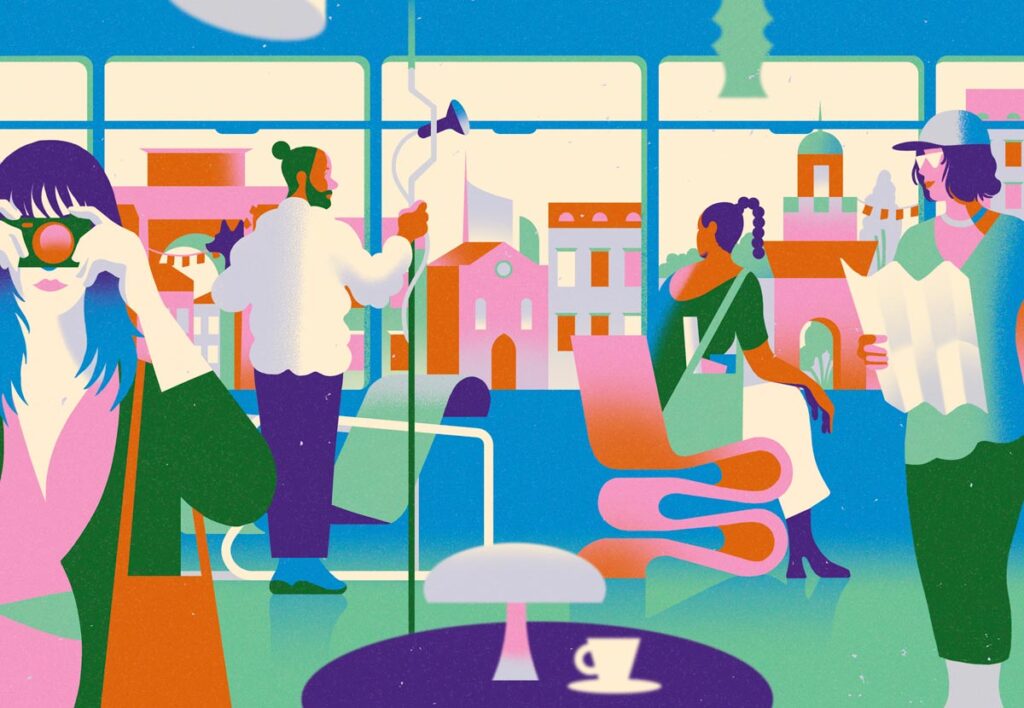
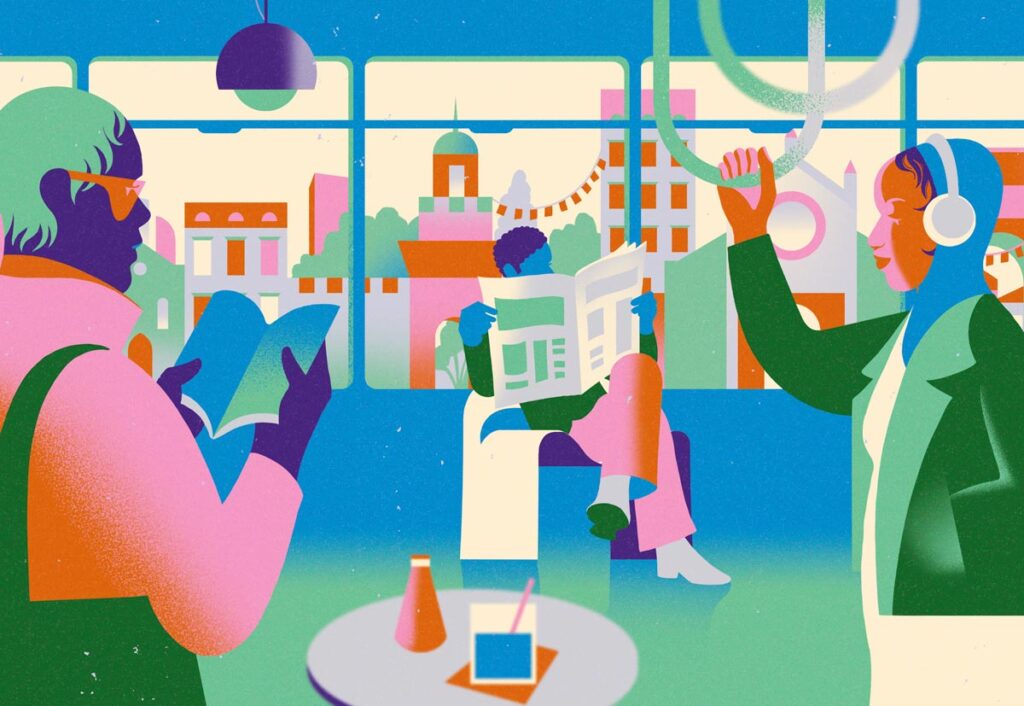
The new image of the Brera Design District takes us on a journey aboard a Milanese tram
Born in Milan in 1990, Chiara Ghigliazza is an award-winning illustrator and collaborates with leading Italian and international companies. For Brera Design Week 2026 she has captured a view from the city’s oldest and most beloved means of transport: the tram. We asked her a few questions to find out more about her, her career, and her creative process.
You chose to depict one of the city’s most iconic symbols. How did this idea come about?
My work is rather sedentary and introspective, so I often need to look outside for inspiration. Traveling by tram has become a little habit of mine, because watching the landscape go by outside the window helps me clear my mind and daydream. It’s a particularly useful habit when I feel short of ideas.
The tram makes me feel a bit like a tourist in my own city; it allows me to observe familiar places from a different angle and rediscover them. Being on the move perfectly captures the spirit of Milan, just like bouncing from one location to another — exploring and getting lost is my way of experiencing the Design Week.
How did you get into illustration and how has your career evolved so far?
I have always studied art and cultivated drawing with different techniques and languages. When I was younger, I was oriented towards comics, then I studied engraving at the Brera Academy, had a brief stint as a tattoo artist, and finally found my way by attending a master’s degree in editorial illustration at Mimaster.
I started working as a freelancer in 2015, initially with Italian magazines and publishers, and soon my circle expanded to include international clients and collaborations with companies in various sectors.
Your illustrations stand out for their bold color combinations. How do you choose your color palettes?
I come from a completely black-and-white background, so it took me a while to introduce color into my life and work. Today I find it a very enjoyable part of the creative process, where images gain depth and character.
I choose palettes very instinctively. I usually start with a color that matches the atmosphere I want to convey, and from there the combinations develop naturally. I have a few favorite colors that tend to emerge in my illustrations, but I always try to expand my color archive. Wherever I go, I take note of the color combinations that strike me—in people’s clothes, building facades, landscapes—and then embody them into my work.
As a digital illustrator, what is your relationship with paper?
When I started working as an illustrator, I moved almost entirely to digital in order to respond to fast turnaround times and corrections. The sketchbook remained a secondary tool used only for quick doodles and notes to fix ideas during the brainstorming phase.
In recent years, I have felt the need to reintroduce paper into my process. Working on a traditional medium allows me to take a more spontaneous approach, where I am less in control. This transition is very therapeutic because it forces me to face my fear of mistakes and imperfection, which potentially do not exist in digital, but are fundamental characteristics in creative processes.
Traveling by tram has become a little habit of mine, because watching the landscape go by outside the window helps me clear my mind and daydream. The tram makes me feel a bit like a tourist in my own city; it allows me to observe familiar places from a different angle and to rediscover them.
Chiara Ghigliazza
Tell us about your creative process: how do you create your illustrations?
I start with a research phase to identify the fundamental concepts of the theme I am working on and to look for further information if necessary. Later I make associations with other words that stem from the original concepts. The goal is to convert something abstract into concrete symbols that can be drawn. Once I have defined the symbols, I combine them in different ways: I reverse their meaning, change their size, relationships, and position, looking for a combination that can communicate the subject in a clear and original way. At this stage, I make quick sketches, and when I find an idea that works, I sketch a composition that enhances it while respecting the constraints of the project. Finally, I try out color combinations and define the final image.
What are your main sources of inspiration?
Much of my inspiration comes from my everyday circumstances, situations and moments, or even clichés. I play around with them from a different perspective, turning them upside down or exaggerating them, until they become something paradoxical or amusing.
I also draw inspiration from other people’s creativity: films, books, exhibitions, workshops, chats with colleagues. All these experiences settle in my mind and create fertile ground. When I sit down at my desk, I draw on this material and rework it into ideas and images.
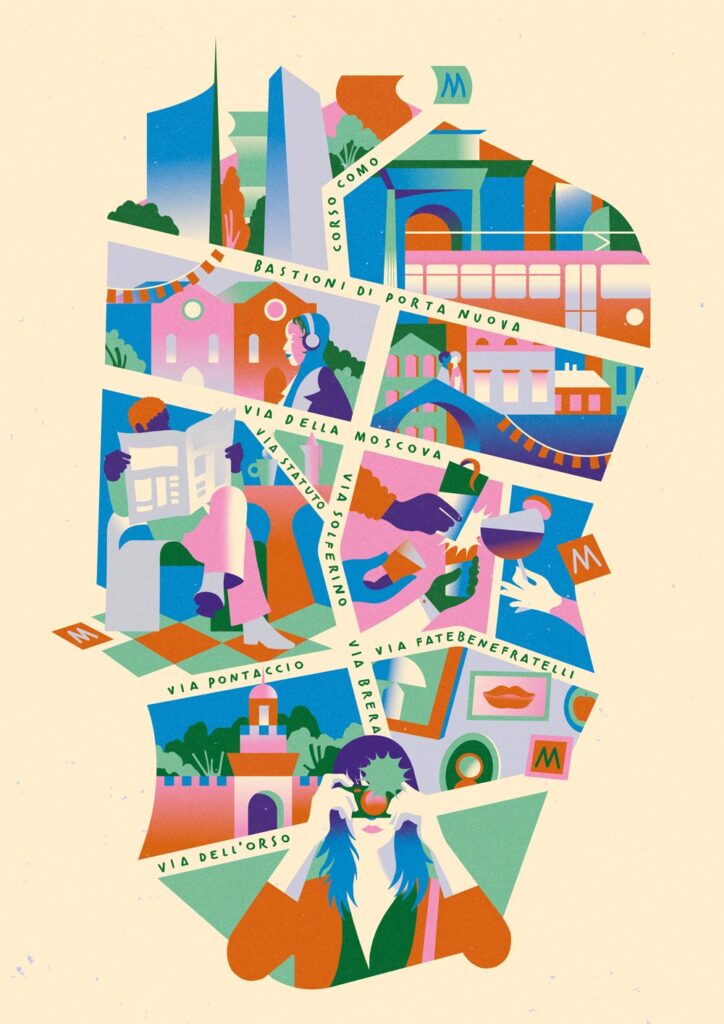
The illustrations for Brera were animated by the motion design studio Alkanoids. Had you worked together before? What is your experience with animation?
All the animation projects I have worked on so far have been done together with Alkanoids. Working with them is extremely stimulating; they are very focused and always look for new and unconventional solutions.
I am fascinated by animation because adding the dimension of time allows you to realize ideas that are completely different from static illustrations, playing with rhythm and the viewer’s perception. It is a language that I would like to integrate more often into my work, as it opens up very interesting narrative and visual possibilities.
I also enjoy experimenting on my own by animating just tiny details of my illustrations, which creates a feeling of subtle movement.
What is the first word that comes to mind when you think of Brera?
Accademia, which is the art school where I studied engraving.
What is your favorite spot in Brera?
There are too many! The cobbled streets behind the Carmine church, the fine art shops, the botanical garden where I spent so many lunch breaks.
What is your relationship with Milan Design Week? Do you always visit Brera during Fuorisalone?
I always try to take a few days off during Design Week so I can see everything. I especially like going to places that are normally closed to the public, and I love seeing how contemporary objects and installations interact with the historic buildings in which they are placed.
Brera is a must-see for me. It’s one of the most beautiful neighborhoods in Milan, and during Fuorisalone, it comes alive in a special way.
Chiara Ghigliazza is a Milan-based illustrator born in 1990. After a degree in traditional printmaking, she studied Editorial Illustration. Since 2015, she has worked with Italian and international publishers, periodicals, and companies, including Sky, Amazon, Emergency, The New York Times, The Washington Post, Les Echos, La Repubblica, and Iperborea. Her work has been recognized in international awards such as American Illustration, 3×3, AOI, and Communication Arts. Her illustrations balance simplicity with depth, transforming abstract ideas into suggestive metaphors.
Her illustrations fro Brera Design Week are animated by Alkanoids, a Milan-based design studio with a strong focus on motion graphics.

